
Picture a medical call at two in the morning. A man meets you at the door talking fast and pointing down the hall, and none of it is in English. His wife is on the bedroom floor, gray and gasping. Your medic asks how long she's been like this, and the question just hangs there. One of your people dials the interpreter line. Another pulls out a phone app. Your medic is still waiting on the answer.
Every department has a version of that call, and I think every department already knows what fixes it, which is somebody on the crew who speaks the language. What's actually interesting in the research is how rarely departments manage to have that person, and how little anyone has done about building one from the people already on the roster.
Everyone already relies on the person in the room
When the Vera Institute looked at how law-enforcement agencies deal with limited-English speakers, 93 percent said they rely on bilingual officers, well ahead of phone interpretation at 67 percent (Shah and Estrada, 2009). The reason is timing. A person in the room can ask the question the moment it comes up, and the research is fairly clear that the decisive moments of a call come early.
Cardiac arrest is the cleanest place to see it, because dispatch centers timestamp everything. Across ten years of arrests in King County, Washington, call-takers took twice as long to recognize an arrest when the caller had a language barrier, two minutes instead of one, and twice as long to get a bystander pressing on the chest (Joshi, 2025). Los Angeles and an Australian ambulance service found the same direction (Sanko, 2021; Perera, 2021).
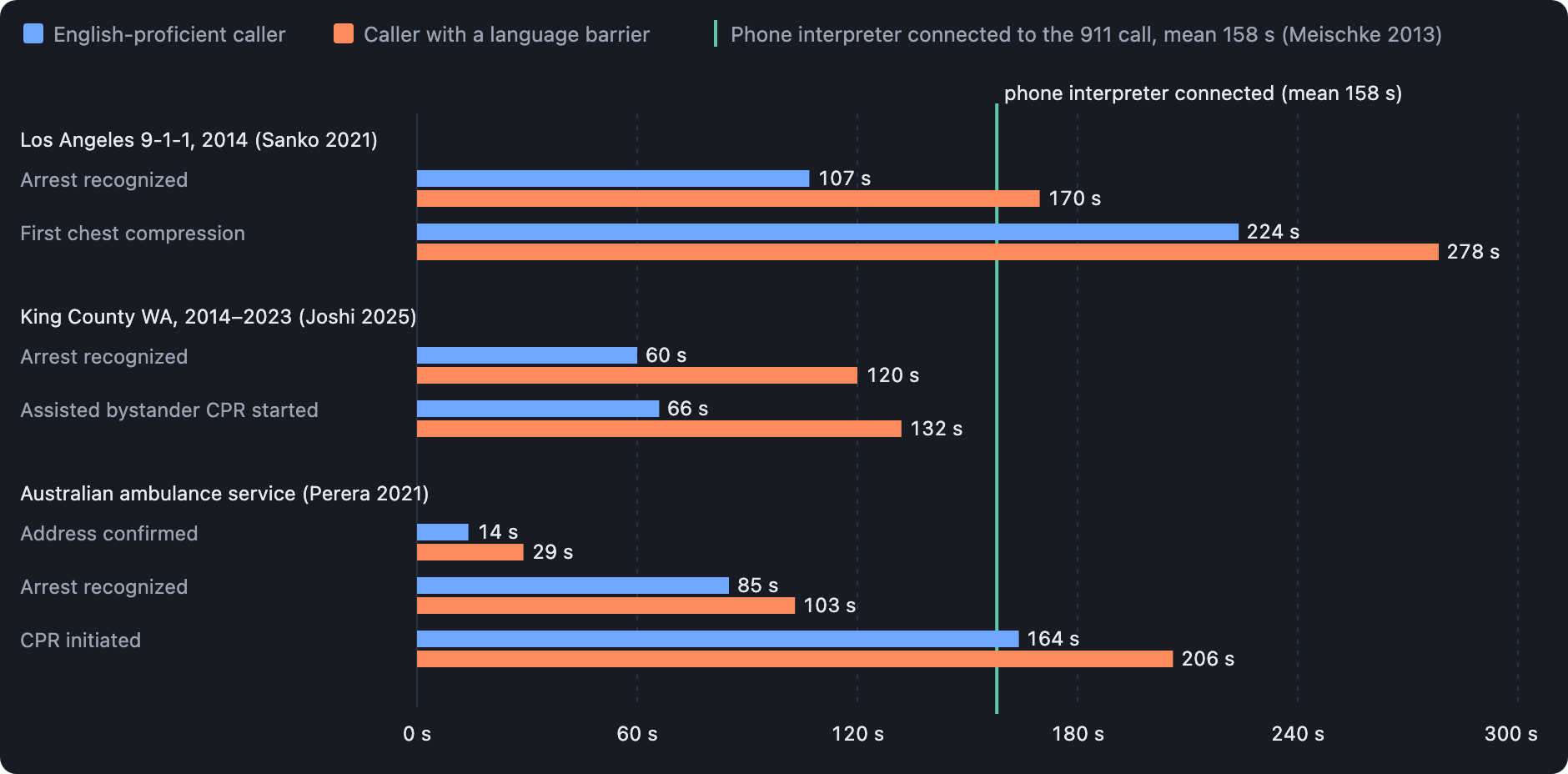
Seconds from the start of the 911 call to arrest recognition and first compressions in three dispatch systems. The green line is the mean phone-interpreter connection in the one dispatch center that timed it (Meischke, 2013).
On scene the same problem shows up as a missing history. In a recent survey of Marin County EMS providers, 80 percent said they had trouble getting an adequate history across a language barrier (Ballard, 2025). Providers in focus groups "reported transporting most patients with LEP to hospitals regardless of illness severity due to concern for miscommunication of symptoms" (Stadeli, 2023), and the national records agree: patients with a non-English preference are about half as likely to be left on scene (Kurkurina, 2025). Those same focus groups also said what would help. They wanted "hellos and goodbyes in their native languages," because "it goes a long way for first impression, and calming them down" (Stadeli, 2023). What they're describing is a colleague who speaks some of the language.
Why hiring hasn't closed the gap
If the bilingual employee is what everyone wants, the obvious move is to hire more of them. In a survey of Oregon fire and police departments, half reported that fewer than one percent of their employees could communicate with a Spanish-speaking customer, even though a quarter of those departments served communities that were more than 11 percent Latino (Burnett, 2003). Hiring in general has only gotten harder; more than 70 percent of agencies in the IACP's 2024 survey said recruiting is more difficult than five years ago (IACP, 2024).
Bilingual pay is the usual lever, and it's worth being honest about it. San Diego pays 70 cents an hour, Fort Worth pays $100 a month, and Chandler, Arizona goes up to 5 percent. A differential like that is a fair way to recognize people who already speak the language, but it doesn't produce any new ones.
There's a more useful idea further down in the Vera report. The Oklahoma City Police Department set up a Bilingual Unit, tested every officer's language ability with standardized ACTFL exams, and ranked them by proficiency. The most fluent handle interrogations, and the less fluent handle the everyday contacts that don't need that level, which gives everyone below the top an incentive to keep improving (Shah and Estrada, 2009). That's an agency saying in policy that partial proficiency has real work to do.
What crews use instead
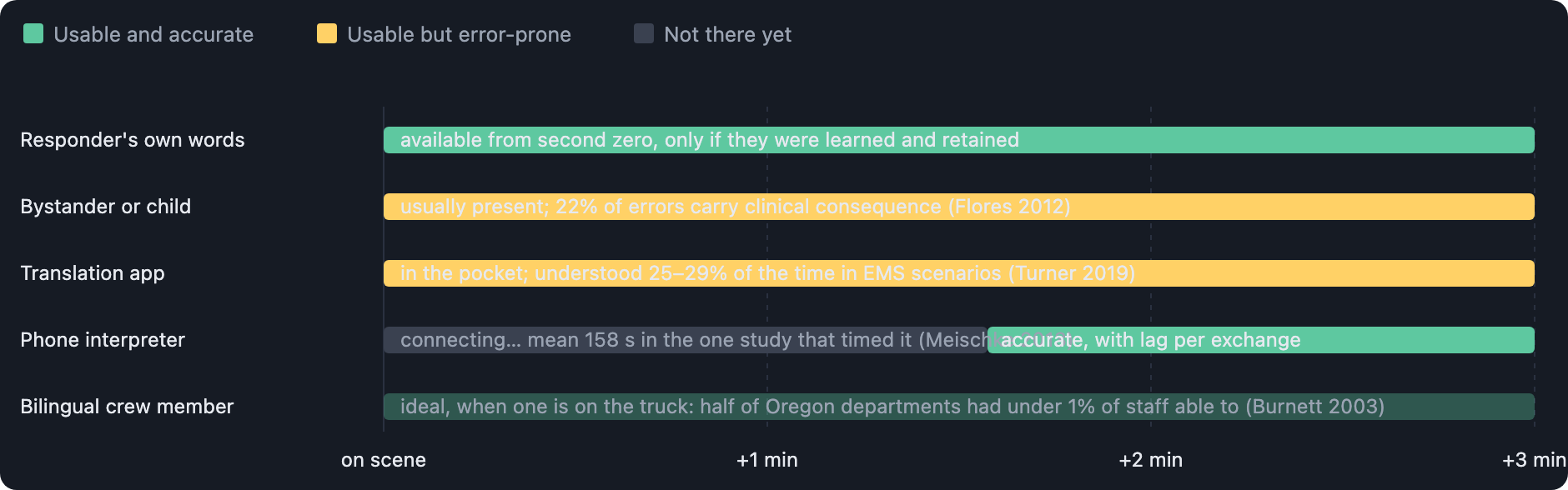
Five ways to reach the patient in the first three minutes on scene, and when each becomes usable.
The phone interpreter is the most reliable substitute once it's connected. Connecting is the problem. The one study that timed it, at a dispatch center, found a mean of 158 seconds (Meischke, 2013). Some centers report faster connections, but after the connection every exchange carries the lag; in one trial, first compressions came almost two minutes later when the CPR instructions went through an interpreter (Meischke, 2014). Dispatchers name the line as their primary strategy and then use it on 13 percent of calls (Meischke, 2010), and the crews in the focus groups put it about the way you'd expect: "sometimes you just get this long lag, and you're really not sure" (Stadeli, 2023).
The translation app has the opposite problem. It's instant, and it's wrong a lot. Spanish- and Chinese-speaking volunteers understood questions asked through Google Translate 29 and 25 percent of the time (Turner, 2019). Nearly half of the Marin County providers use one anyway (Ballard, 2025).
The bystander or child is the substitute crews actually reach for most, with 89 percent of those providers relying on family or friends to interpret (Ballard, 2025). The trouble is accuracy. Untrained interpreters' mistakes carried potential clinical consequences nearly twice as often as professionals' (Flores, 2012), and a Santa Clara County grand jury had to remind officers not to let the alleged abuser interpret for a domestic-violence victim (2006).
Each of these is what a crew does when nobody on the truck speaks the language, and in the minutes that decide the call they are either late or unreliable.
Building bilingual employees from the people you have
Since hiring can't supply enough of them, the remaining option is to make them, and the evidence that departments have seriously tried is thin. In the Oregon survey more than half had taken no step at all, a fifth used phrase cards, and under half said they would pay for language training (Burnett, 2003). The class most departments would buy puts the words in once, as a list, and by the time a call needs them months later most of them have gone. Whether any of that training holds up on a real call has never actually been tested; a review of the prehospital literature found no study of responder language training at all (Tate, 2015), and I found none since.
So it's worth being precise about what "bilingual" has to mean for this job, because it's narrower than the word suggests. A responder needs to say who they are and what they're about to do, ask the handful of questions that decide acuity, understand the answers under stress, and say that an interpreter is on the way. Consent, medication instructions and formal statements still go through a certified interpreter, in the same way Oklahoma City sends interrogations to its most fluent officers. That's a lower rung on the same ladder, and it's the rung a department can build.
That is what Synapse is designed to do, and the retention problem is the part it's built around. Each word you learn comes with a picture, a native speaker's voice, the written form and a situation it belongs to, so your memory has more than one way back to it, and review comes due right before you'd forget (the July post on Multi-Synaptic Neural Training covers the science). Practice conversations, typed or spoken, with replies in a native speaker's voice, so the first time you hear "me duele el pecho" isn't on a call. Lessons are short and happen on a phone between calls, and Spanish, Mandarin Chinese, Vietnamese, Korean and Arabic are among the 26 languages available.
There's also the roster. Administrators enroll by seat and organize by department or unit, leadership sees hours practiced and completion rates for each unit, and finishers earn a verifiable certificate issued by the organization. That's a documented record of who has completed what, which is a better starting point than "I think Dawson speaks some Spanish."
What it means for your department
Nobody has measured whether training responders in a second language changes survival or transport rates, because nobody has looked. What it does say is that the decisive minutes of a call come early, that the substitutes are late or unreliable inside them, that agencies already lean on bilingual employees more than on anything else, and that they can't hire enough of them, which leaves building them as the part a department controls.
A reasonable first step is to count your calls by language in the 911 data and decide what your crews should be able to say before the interpreter connects. After that, the honest test is one station for a month. If you'd like to run it, book a demo and we'll get that station started.
Table of Authorities
Ballard, H. W. et al. (2025). Language barriers in the prehospital environment: Prevalence, pitfalls and problem-solving. Journal of Emergency Medical Services, January 9, 2025 (survey of Marin County EMS providers; 109 of 521 responded).
Burnett, M. N. (2003). Enhancing the ability of firefighters to communicate with Spanish speaking customers. U.S. Fire Administration, Executive Fire Officer Program (survey of Oregon fire and police departments; 131 respondents).
City of Chandler, Arizona; City of Fort Worth, Texas; City of San Diego, California. Police bilingual pay schedules, published benefits pages, 2024–2025.
Flores, G. et al. (2012). Errors of medical interpretation and their potential clinical consequences: A comparison of professional versus ad hoc versus no interpreters. Annals of Emergency Medicine, 60(5).
International Association of Chiefs of Police (2024). The state of recruitment and retention: A continuing crisis for policing. 2024 survey results (1,158 agencies).
Joshi, I. et al. (2025). Impact of language barrier during emergency call on out of hospital cardiac arrest treatment and outcomes. Resuscitation (King County, 2014 to 2023).
Kurkurina, E. et al. (2025). Emergency medical services time on scene and non-transport: Role of communication barriers. Western Journal of Emergency Medicine, 26(5).
Meischke, H. et al. (2010). Emergency communications with limited-English-proficiency populations. Prehospital Emergency Care, 14(2).
Meischke, H. et al. (2013). The effect of language barriers on dispatching EMS response. Prehospital Emergency Care, 17(4).
Meischke, H. et al. (2014). The effect of language barriers on dispatcher-assisted CPR: A randomized trial (139 limited-English adults speaking Mandarin, Cantonese or Spanish; summarized in Tate, 2015).
Perera, N. et al. (2021). "I'm sorry, my English not very good": Tracking differences between language-barrier and non-language-barrier emergency ambulance calls for out-of-hospital cardiac arrest. Resuscitation, 169.
Sanko, S. et al. (2021). Comparison of emergency medical dispatch systems for performance of telecommunicator-assisted cardiopulmonary resuscitation among 9-1-1 callers with limited English proficiency. JAMA Network Open, 4(6).
Santa Clara County Civil Grand Jury (2006). Reducing language barriers in domestic violence calls. 2005–2006 Civil Grand Jury report, County of Santa Clara.
Shah, S. & Estrada, R. (2009). Bridging the language divide: Promising practices for law enforcement. Vera Institute of Justice and U.S. Department of Justice, Office of Community Oriented Policing Services (Oklahoma City Police Department Bilingual Unit profile, p. 12).
Stadeli, K. M. et al. (2023). Perceptions of prehospital care for patients with limited English proficiency among emergency medical technicians and paramedics. JAMA Network Open, 6(1).
Tate, R. C. (2015). The need for more prehospital research on language barriers: A narrative review. Western Journal of Emergency Medicine, 16(7).
Turner, A. M. et al. (2019). Evaluating the usefulness of translation technologies for emergency response communication: A scenario-based study. JMIR Public Health and Surveillance, 5(1).